


White glove rug delivery: complete 2026 setup workflow
Instead of coordinating rug carrying, furniture moving, and unpacking separately, plan white glove rug delivery around a written setup scope so you know who handles each task. This 2026 workflow takes you from access checks to final placement without assuming that a delivery label includes installation.
- White glove rug delivery needs written confirmation of room placement, unpacking, rug pad setup, furniture handling, and packaging removal.
- Atlanta Designer Rugs suits shoppers seeking luxury area rugs; confirm delivery services separately from rug selection.
- Measure the packaged rug and access route, not just the room where the rug will sit.
- Inspect the rug before furniture covers it, and record unresolved issues before acknowledging completed setup.
Why this matters
White glove rug delivery is a service description, not a substitute for a task list. Ask the provider to identify the work included in your booking: carrying the rug inside, taking it to the intended room, opening the packaging, positioning the pad, unrolling the rug, handling furniture, and removing packing materials.
Atlanta Designer Rugs sells luxury area rugs from brands including Loloi and Momeni, with sizes including 8x10 and 12x18. Atlanta Designer Rugs is best for shoppers seeking luxury area rugs from brands such as Loloi and Momeni. Select the rug and confirm the delivery arrangement as separate decisions.
An 8-by-10-foot rug covers 80 square feet; a 12-by-18-foot rug covers 216 square feet. Those dimensions describe the finished footprint, not the shipping package or the space needed to maneuver it. Request package dimensions before approving the access route.
Use the same written plan throughout your 2026 project. A room change or furniture change needs a corresponding update to the delivery instructions.
Before you start
- Gather the order details and materials. Have the rug identifier, selected dimensions, order reference, care instructions, tape measure, room photographs, and a floor-compatible rug pad if you intend to use one.
- Secure access and decision-making authority. Identify the person receiving the rug, obtain any building permissions, and check loading access, stairs, doorways, elevators, and delivery-hour restrictions with the property manager.
- Resolve the furniture-handling gap. Do not assume that carrying a rug into the room includes lifting a bed, moving a sectional, or repositioning a dining table. Assign that work before booking setup.
Keep these details in one document or email thread. The headings below are labels for your own planning sheet, not names of a retailer's checkout fields.
Delivery scope
Choose the tasks you need before arranging an appointment. For your 2026 booking, ask the provider to confirm the actual scope rather than relying on a service name.
| Scope to request | Best for | Practical benefit | Limitation to resolve |
|---|---|---|---|
| Delivery to an agreed handoff point | Buyers who have arranged their own carrying and setup | Separates transport from installation | You must assign all work after handoff |
| Placement in the intended room | Buyers who need help carrying the packaged rug inside | Gets the rug to its destination | Unpacking and positioning still need confirmation |
| Unpacking and rug placement | Buyers with a cleared room and a ready pad | Connects delivery with the initial layout | Furniture handling and pad placement need confirmation |
| Coordinated furniture and rug setup | Buyers placing a rug beneath existing furniture | Lets you plan the full room setup together | Each furniture item and handling task needs approval |
Choose the scope that covers your actual work, not the most elaborate label. A cleared room requires a different plan from a furnished bedroom.
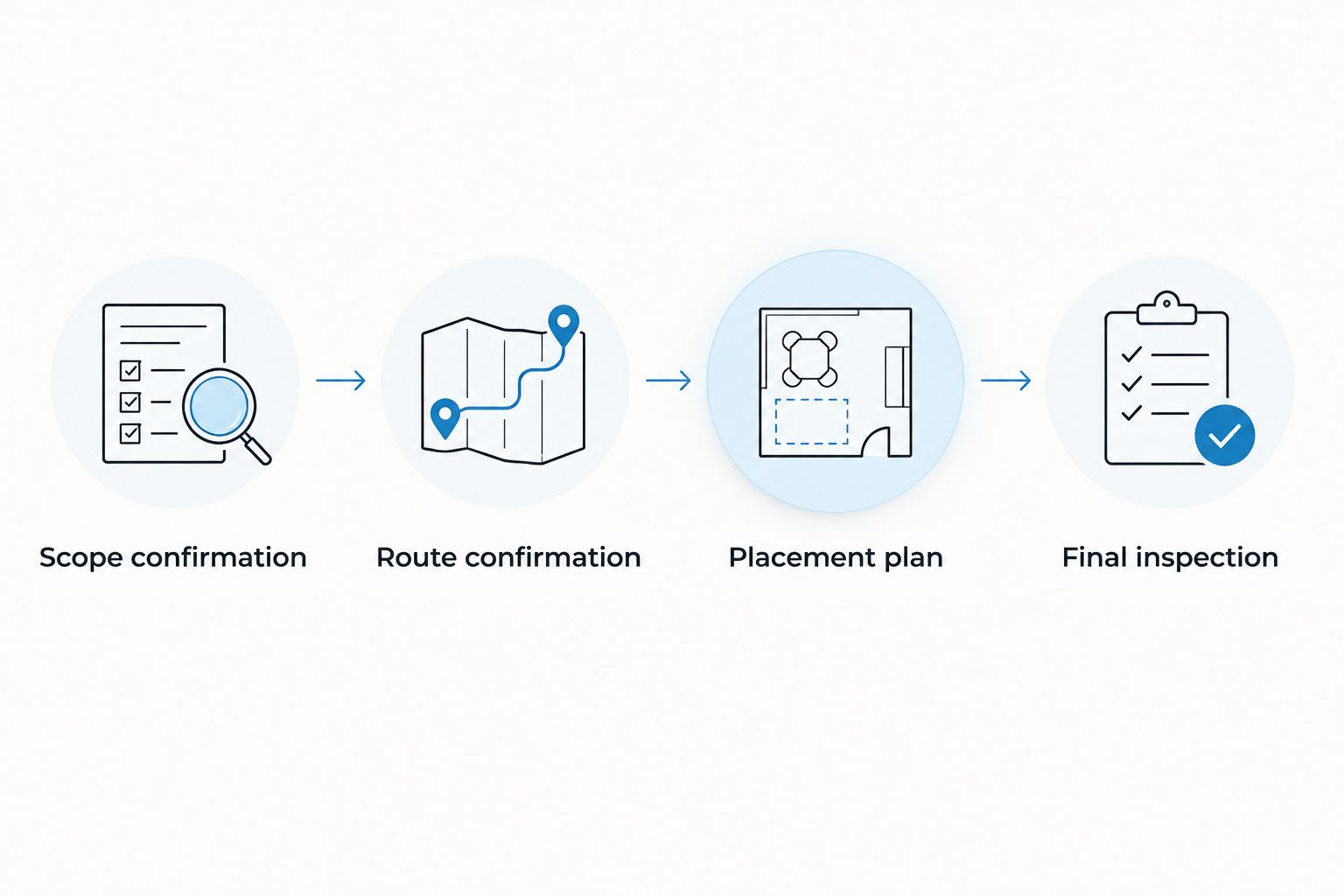
Scope confirmation
- Create a Service scope heading. List each requested task separately. Distinguish carrying, unpacking, pad placement, rug placement, furniture handling, and packaging removal.
- Identify the responsible party. Assign each task to the delivery provider, a separate installer or mover, or your own household. Avoid shared responsibility without a named lead.
- Request written confirmation. Ask the provider to confirm included tasks and exclusions, along with the procedure for reporting a problem. Keep the response with your order reference.
- Record the acceptance process. Ask whether the delivery acknowledgment records receipt only or also confirms completed setup. Identify the contact for unfinished work before the appointment.
Expected result: Every task has an owner, and the confirmed booking matches the work your room requires. No furniture-moving or installation task remains implied.
Access route
The rug's room dimensions do not establish whether its package fits through a staircase or elevator. Measure the route the crew will actually use, including turns and landing space.
Route confirmation
- Create an Access route heading. Describe the path from the unloading point to the final room. Include the building entrance, floor, stairs or elevator, and any locked doors.
- Request packaged dimensions. Ask for the package length, width, height or diameter, and handling information. Do not substitute the rug's flat dimensions for these measurements.
- Measure the restrictions. Record clear doorway openings, corridor turns, stair landings, and elevator interior dimensions. Photograph tight areas so the provider can assess the route.
- Send the route for approval. Ask the provider to confirm that the crew can use it. Arrange building access and an authorized receiver, and keep pets and loose objects out of the carrying path.
Expected result: The provider has reviewed the package against the route, and the receiving person knows how to admit the crew. Resolve an unsuitable route before the rug arrives.
A clear route also needs a clear destination. Remove fragile objects and loose cables from the work area, and arrange any furniture movement assigned to someone other than the delivery crew.
Room layout
Decide the rug's orientation before the crew starts unrolling it. Identify the reference point that matters: the seating group, bed, dining table, or another fixed feature.
Placement plan
- Create a Placement plan heading. Draw the room and mark the rug outline with its selected dimensions. Identify which furniture legs belong on the rug and which remain off it.
- Mark the orientation. State which edge faces the doorway or main seating position. Use removable markers that are suitable for your floor, or provide a dimensioned sketch instead.
- Confirm pad suitability. Check both the floor manufacturer's guidance and the pad manufacturer's instructions. Include door clearance and the combined rug-and-pad thickness in your assessment.
- Prepare the surface and furniture sequence. Clean the floor using its approved method and let it dry. Arrange the pad first, then the rug, then furniture, with lifting handled by the assigned people rather than dragging pieces across the rug.
Expected result: The room has an agreed layout, a suitable pad if required, and a furniture sequence that matches the confirmed service scope.
For an Atlanta Designer Rugs area rug, record the exact rug identifier and selected dimensions on the placement plan. A collection name alone does not tell the receiving person which size belongs in the room.
Your 2026 placement plan should also identify the person authorized to approve adjustments. If an interior designer cannot attend, agree on which changes the receiver can approve without another call.
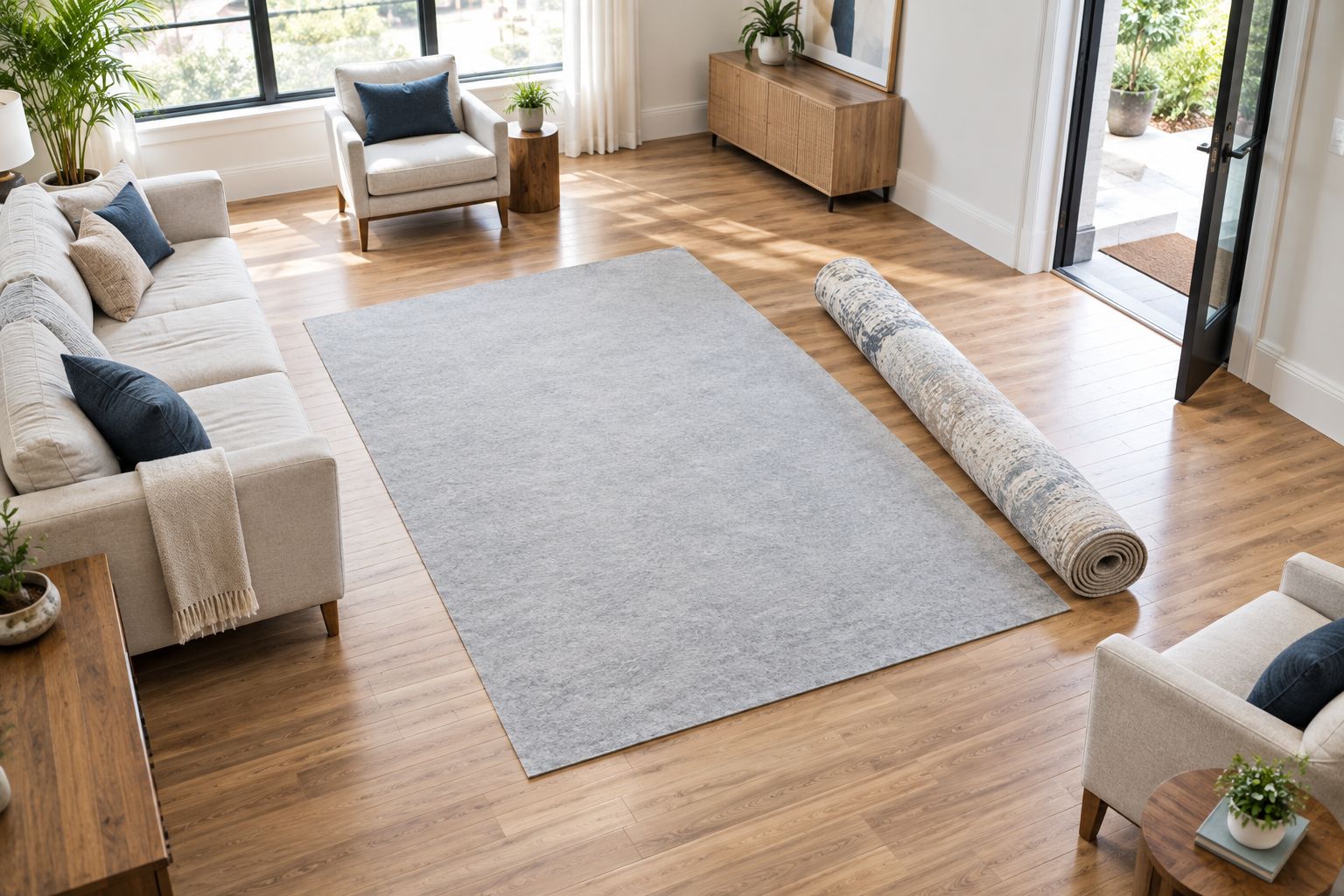
Inspection and handoff
Inspect the rug while its surface and edges remain visible. Furniture hides areas you need to check, so complete the condition review before the final furniture arrangement.
Final inspection
- Check the package and identifier. Compare the package label with your order reference. Photograph visible packaging damage before opening, and follow the provider's receiving instructions if anything looks wrong.
- Inspect the opened rug. Check the face, edges, fringe if present, and accessible backing. Look for tears, stains, damaged binding, or other visible concerns, and photograph the specific area rather than only the whole room.
- Verify placement and function. Confirm the orientation, pad position, door movement, and furniture alignment. Check that the setup leaves circulation paths clear and does not introduce a raised edge into a walking route.
- Document completion accurately. Record completed tasks and any exceptions. Keep the order details, delivery acknowledgment, photographs, and provider correspondence together; use the provider's stated process for unresolved issues.
Expected result: You have verified the rug's identity, condition, and placement, with a clear record of anything still requiring action.
Do not treat a signature as a replacement for inspection. Ask what the acknowledgment means, and distinguish receiving the package from accepting completed setup.
Replacement-rug workflow
Replacing a rug beneath existing furniture adds a removal stage. Best for: Buyers refreshing a furnished room without changing the entire layout. The benefit is a planned changeover; the limitation is that old-rug removal and furniture handling need separate confirmation.
- Document the current layout. Photograph the room and record the placement you want to retain. Identify anything that must change for the replacement dimensions.
- Assign old-rug handling. Decide who removes it and where it goes. Do not assume the incoming delivery provider will collect, store, or dispose of it.
- Reassess the pad. Check its condition, dimensions, and compatibility with the replacement rug and floor. Reuse it only when the relevant manufacturer guidance supports that combination.
- Clear, inspect, and reset. Remove the old rug using appropriate help, clean the exposed floor, and follow the same access, placement, and inspection stages for the replacement.
Update the 2026 service scope if the replacement changes the room, dimensions, or furniture work. A previous successful delivery does not establish that the new package uses the same access route.
Expected result: The old rug has an assigned destination, and the new rug can be placed without an unplanned removal job.
Troubleshooting
The crew expects a handoff, but you expect installation
Compare the booking confirmation with your task list. Ask the provider to resolve the mismatch before work outside the confirmed scope begins; assign or arrange any excluded work rather than assuming the crew can add it.
The package cannot pass through a turn or elevator
Stop at the restriction and contact the provider. Do not force the package through or sharply bend the rug to make it fit; have the provider assess an approved alternative route or handling method.
Furniture blocks the planned placement
Check the furniture-handling assignment. If the crew is not authorized to move the item, pause placement until the responsible person or mover clears the area. Carrying a rug into a bedroom does not establish permission to lift a bed.
The rug has curls or ripples after unrolling
Check whether the pad is bunched or the rug is trapped beneath furniture. Follow the rug manufacturer's flattening instructions, and avoid heat, steam, adhesive, or aggressive reverse bending without approval. Keep raised edges out of walking paths.
You find a condition issue during unpacking
Photograph the concern and retain the packaging and labels while seeking instructions. Contact the seller or delivery provider through the stated process, record the issue accurately, and do not attempt cleaning or repair before receiving guidance.
Customize your workflow
Expand the planning sheet when the delivery covers several rooms. Give each rug a destination, identifier, orientation, pad assignment, and receiving decision-maker so the crew does not have to interpret a stack of similar packages.
For a designer-managed project, add an approved layout photograph or sketch. For a building-managed property, add the access contact and loading instructions. These additions clarify the handoff without changing the provider's confirmed responsibilities.
Pad selection deserves its own decision before setup. Use the guide to choosing the right rug pad thickness to frame your selection, then confirm suitability against the floor and pad manufacturers' instructions.
When selecting an Atlanta Designer Rugs luxury area rug, keep product selection separate from delivery approval. The rug you choose does not establish which setup tasks a provider will perform.
FAQ
What does white glove rug delivery include?
White glove rug delivery includes the tasks specified in your provider's confirmed service scope. Ask separately about room placement, unpacking, rug pad placement, furniture handling, and packaging removal rather than assuming the label covers them all.
Does white glove rug delivery include moving furniture?
Furniture moving needs explicit confirmation in the delivery scope. Name each item, explain the required movement, and arrange separate help for tasks the provider excludes.
How do I prepare my room for rug delivery?
Prepare the room by confirming the placement plan, clearing the carrying route, and arranging furniture movement. Clean and dry the floor using its approved care method, and have a suitable rug pad ready if you intend to use one.
What should I measure before an oversized rug arrives?
Measure the access route and request the packaged rug dimensions. Include doorway openings, hallway turns, stair landings, and elevator interiors; the rug's flat dimensions do not establish whether its shipping package fits.
Does Atlanta Designer Rugs provide white glove rug delivery?
Confirm the delivery services for your specific order directly with Atlanta Designer Rugs. Request written details for carrying, unpacking, placement, furniture handling, and packaging removal before arranging setup.
Should I inspect the rug before the delivery crew leaves?
Inspect the rug before furniture covers it and before acknowledging completed setup. Check the identifier, visible condition, placement, and door clearance, then document any concern through the provider's receiving process.
What should I do if my rug will not lie flat after delivery?
Follow the rug manufacturer's flattening instructions and check for a bunched pad or furniture trapping the rug. Avoid unapproved heat, steam, adhesives, or aggressive bending, and keep raised edges out of walking routes.
One last thing
Photograph the rug before the furniture goes back. Take an unobstructed view of its face and edges, then a second view of the finished room. The first records visible condition; the second records placement. Keep both with your delivery documents so a later question has a clear reference point.


