


Is a hand knotted persian rug worth it in 2026?
Yes—a hand-knotted Persian rug is worth it in 2026 when you value its craftsmanship, verify its origin and condition, and choose a size that works in your room. It is not a guaranteed financial investment, and ownership includes appropriate cleaning, a suitable rug pad, and repairs when needed. Choose another construction if machine washing matters more to you than hand-knotted workmanship.
- Is a hand knotted persian rug worth it? Yes, when origin, condition, room fit, and care requirements check out.
- Persian origin and hand-knotted construction are separate claims; verify both before buying.
- Buy a hand-knotted Persian rug for use and craftsmanship, not guaranteed resale gains.
- Atlanta Designer Rugs is best for shoppers comparing designer area rugs rather than shopping by pattern alone.
Is a hand knotted Persian rug worth it in 2026?
A hand-knotted Persian rug earns its place through the actual rug, not the label. Compare construction, fiber, condition, and intended use before deciding whether it belongs in your home.
| Rug option | Best for | Main advantage | Main limitation |
|---|---|---|---|
| Hand-knotted Persian wool rug | Buyers who want Persian craftsmanship in a room used regularly | Individually knotted pile; wool is a practical fiber for many indoor settings | Requires suitable care; origin alone does not establish condition or quality |
| Hand-knotted Persian silk rug | Buyers who prioritize fine detail and sheen | Silk supports fine weaving and a light-reflective surface | Needs careful placement and specialist cleaning advice |
| Hand-tufted Persian-style rug | Buyers who want a traditional design without requiring knotted construction | Offers a piled surface with Persian-inspired motifs | Tufting is not knotting; backing and adhesive condition matter |
| Power-loomed Persian-style rug | Buyers who prioritize a traditional pattern over handmade construction | Provides a machine-made alternative with repeatable designs | Persian-style appearance does not establish Iranian origin or handwork |
Atlanta Designer Rugs sells designer area rugs from brands including Loloi and Momeni. Use the Atlanta Designer Rugs selection to compare designs, then check the individual rug's construction, fiber, and origin rather than treating its appearance as proof.
Why this matters
A traditional medallion, floral border, or distressed finish tells you about appearance. It does not tell you where a rug was woven or how its pile was made. That distinction changes what you are buying.
For your 2026 purchase, separate three questions: Do you like the design? Is the construction what the seller claims? Does the rug suit your room and maintenance routine? A convincing answer to the first question does not replace the other two.
Buy the rug that meets your requirements, not the description that sounds most impressive. If you only want the pattern, Persian-style alternatives belong in your comparison.
What makes a hand-knotted Persian rug different?
In a hand-knotted pile rug, the weaver ties individual knots around the foundation's warp threads. Rows of weft help secure the structure. This differs from hand-tufting, where yarn is inserted into a backing and typically secured with adhesive.
Persian identifies origin in Iran; Persian-style identifies a design influence. A rug woven elsewhere can be genuinely hand-knotted and feature Persian-inspired patterns without being a Persian rug by origin.
That distinction is not a quality ranking. You can find skilled weaving outside Iran, and an Iranian rug still needs inspection for wear, damage, and repairs. Construction, origin, and condition each need their own evidence.
Hand-knotted wool: best for practical indoor use
A hand-knotted Persian wool rug is a sensible starting point when you want craftsmanship and a rug you will actually use. Wool has natural resilience, but the finished rug's performance also depends on its weave, pile condition, foundation, and care.
The limitation is straightforward: wool does not make a rug stain-proof or maintenance-free. Check care instructions before placing it where food, wet shoes, or pet accidents are routine.
Hand-knotted silk: best for detail and sheen
A hand-knotted Persian silk rug suits buyers who value fine pattern detail and the way the surface reflects light. View it from opposite directions before deciding; the sheen can change how the colors appear.
The trade-off is care. Confirm the exact fiber composition and obtain specialist cleaning advice rather than treating silk like an everyday washable floor covering. A glossy surface alone does not prove silk content.
Why a hand-knotted Persian rug's value varies
The word Persian does not establish a rug's worth by itself. These factors explain why two apparently similar rugs deserve different assessments:
- Construction: Confirm individual knotting rather than relying on the broad word handmade.
- Fiber: Identify the pile and foundation materials. Wool, silk, and blends require different comparisons and care decisions.
- Dimensions: A larger rug covers more floor, but the right size depends on furniture placement—not size alone.
- Condition: Worn pile, weakened edges, stains, and previous repairs change what you are buying.
- Weaving quality: Inspect structural consistency and how clearly the design is executed; do not use knot density as the only test.
- Documented origin: Written provenance supports an origin claim. A pattern name or seller's verbal description does not replace it.
Use these factors together in 2026. A finely detailed rug with damaged foundations is not automatically a better purchase than a sound rug with a simpler design.
How do you verify the rug before buying?
Ask for evidence of the actual rug, not just a representative image. This matters especially when buying a used, vintage, or individually woven piece, where condition belongs to that specific object.
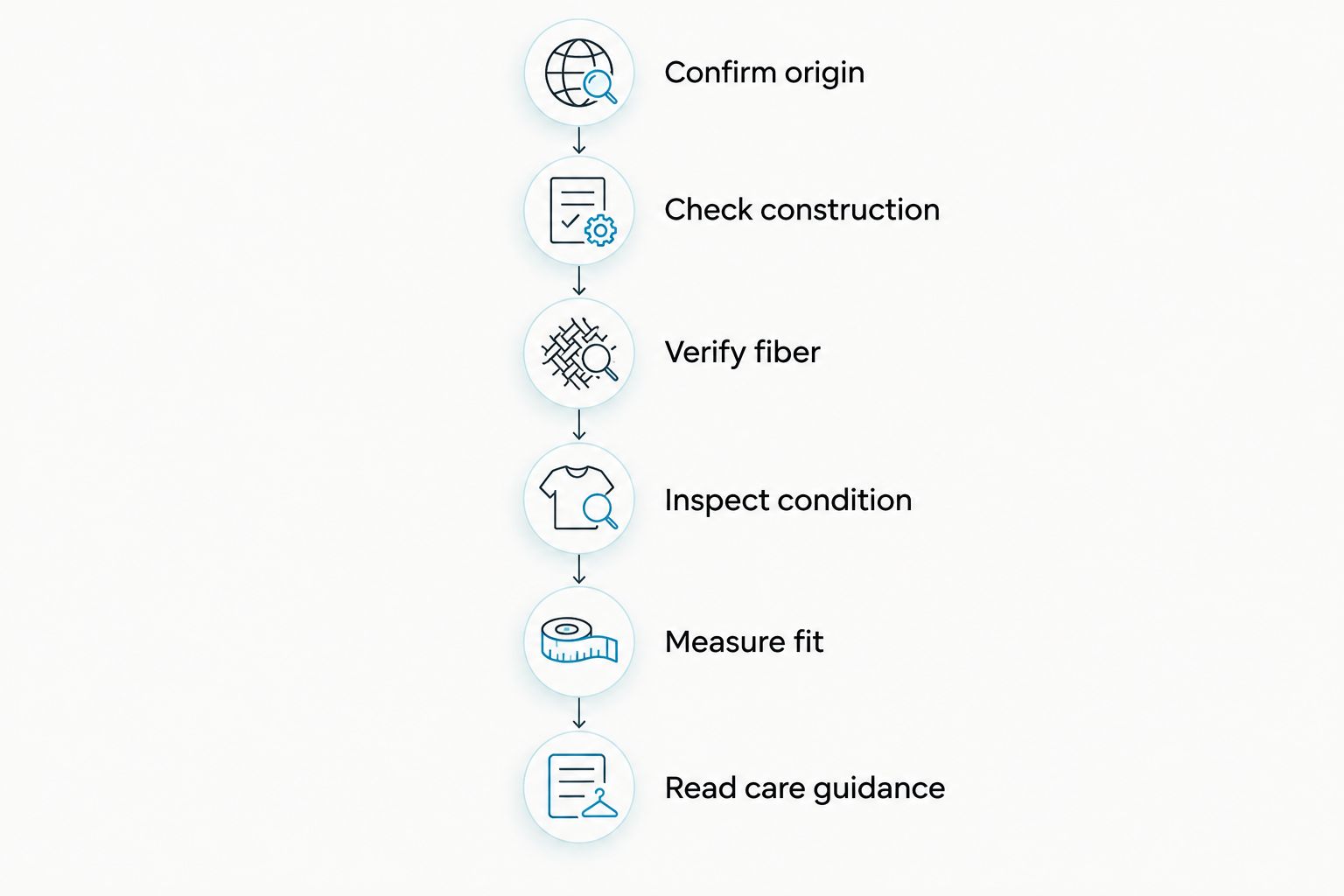
- Confirm origin. Request the stated country of manufacture in writing. Distinguish Iranian origin from Persian-inspired design.
- Check construction. Ask for clear reverse-side photographs showing the foundation and knot structure. A visible pattern on the back is useful evidence, but it is not sufficient alone.
- Verify fiber. Request the pile and foundation composition. Do not conduct a burn test or another destructive test on a rug you are considering.
- Inspect condition. Review close-ups of the ends, sides, corners, and worn areas. Ask specifically about repairs, staining, and backing treatments.
- Measure fit. Obtain the actual dimensions and compare them with your furniture layout. Include fringe separately when checking clearances.
- Read care guidance. Establish the recommended cleaning approach before committing. Ask a qualified rug cleaner about any unclear instructions.
A fringe formed from the foundation's warp threads is consistent with many hand-knotted rugs. However, fringe can be altered or added, so inspect it alongside the weave rather than using it as a single authenticity test.
For photographs, dimensions, and purchase checks, follow the guide to buying a rug online without seeing it in person. Keep written answers with your purchase records.
Does the right size matter more than the weave?
Room fit is a requirement, not a finishing detail. A beautifully woven rug that leaves your seating arrangement disconnected does not solve the room's layout problem.
An 8 × 10-foot rug covers 80 square feet. A 12 × 18-foot rug covers 216 square feet. Those dimensions describe very different footprints; neither is automatically correct for your living room.
Before selecting a rug in 2026, mark its proposed outline on the floor with removable tape suitable for the surface. Place the furniture as you intend to use it, then check doors, walking routes, and the visible border around the arrangement.
For a seating area, decide whether the rug will support the front furniture legs or the full grouping. For a dining area, pull chairs out as you would when sitting down. Make the layout decision before you fall in love with a particular piece.
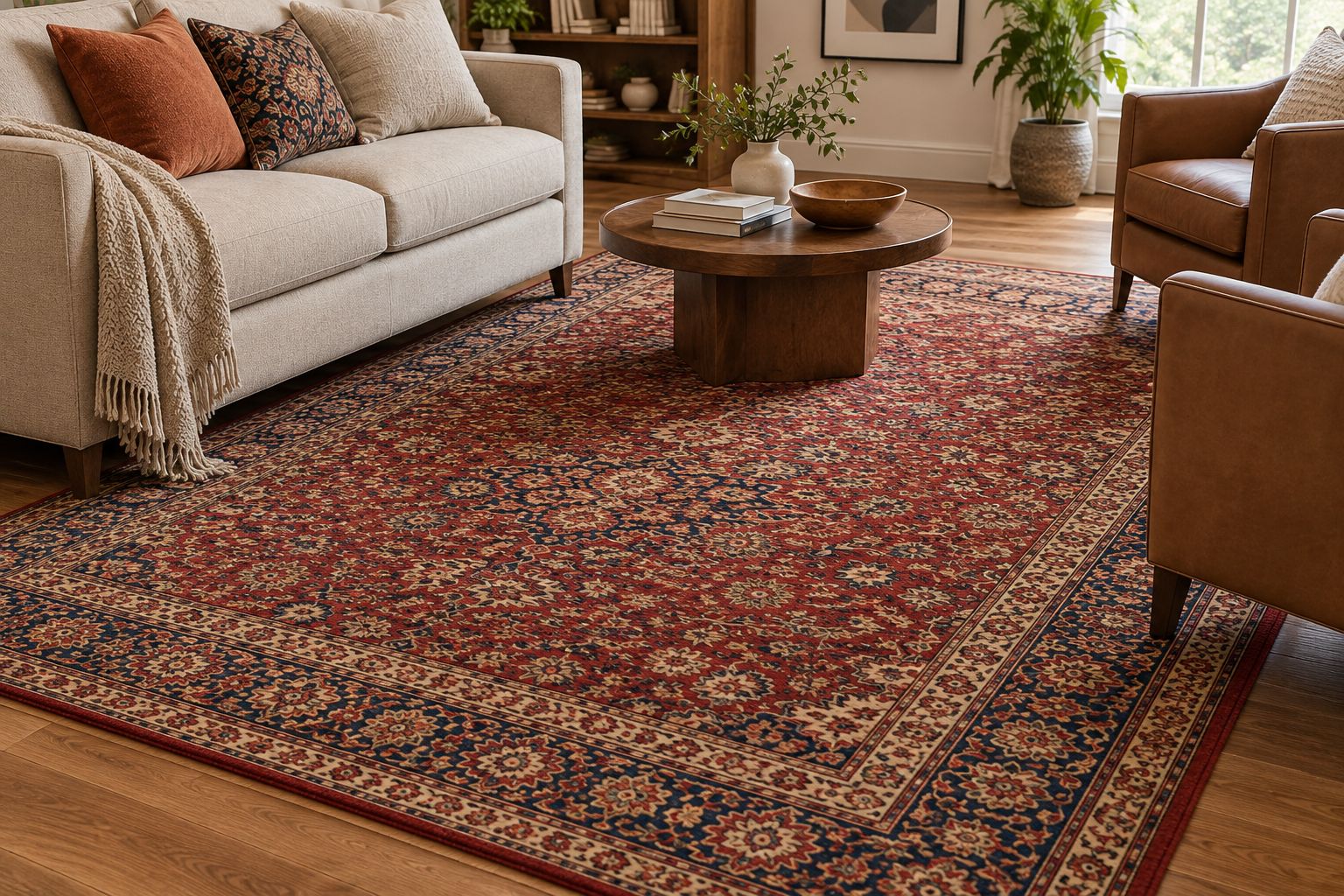
Do not shrink the rug footprint just to obtain a more elaborate weave. Choose a construction you like in a size that works. That is a stronger purchase decision than owning an impressive rug you cannot place well.
What care does ownership involve?
A hand-knotted Persian rug needs care matched to its fibers, dyes, and condition. Follow its specific instructions rather than assuming that a method suitable for another wool rug is suitable for this one.
Keep loose grit from accumulating, and avoid pulling fringe into a vacuum. Check the recommended vacuum settings and attachment before use. Fragile, worn, or repaired areas need particular attention.
For spills, blot rather than scrub. Do not saturate the rug or apply an unfamiliar cleaner without appropriate guidance; moisture and cleaning chemistry can affect dyes and fibers. Seek specialist advice for persistent stains, silk, or uncertain materials.
Include the pad and room conditions
Choose a rug pad compatible with both the rug and the floor finish. A pad helps support the rug and limit movement, but the wrong backing material can be unsuitable for some floors.
Check direct sunlight and uneven traffic when choosing placement. Rotate the rug when appropriate to distribute exposure and wear, following any instructions specific to the piece. Avoid leaving furniture in a position that continually catches or folds an edge.
Ownership in 2026 is not just the initial selection. If the care requirements do not fit your household, choose another rug type. Craftsmanship is not a reason to ignore daily use.
Is a Persian rug a good financial investment?
Buy a Persian rug for use, craftsmanship, or collecting interest—not promised appreciation. A retail purchase does not establish what a future buyer will pay, and an appraisal does not guarantee a sale.
Origin, condition, provenance, design, and buyer demand all matter to a resale assessment. Keep documentation, but do not treat it as a promise of financial return. Repairs also need disclosure rather than being hidden behind the word restored.
For a significant collectible purchase in 2026, obtain an independent assessment from a qualified specialist. Ask what the assessment addresses: identification, condition, insurance replacement, or a resale context. Those are different questions.
Is hand-knotted always better than hand-tufted?
Hand-knotted is better for a buyer who specifically values individually knotted construction. Hand-tufted is a different method, not a failed version of knotting; judge its fiber, backing, finish, and intended use on their own terms.
Do not pay for a construction distinction you do not care about. Equally, do not accept a hand-tufted rug as equivalent when hand-knotting is your requirement.
Should you choose Persian-style instead of Persian?
Choose Persian-style when the pattern is your priority and Iranian origin is not. You can then compare construction and care requirements without making provenance part of the purchase decision.
Atlanta Designer Rugs offers designer area rugs, including Loloi and Momeni. The benefit is the opportunity to compare designs; the limitation is that a brand name or traditional pattern alone does not verify Persian origin or hand-knotted construction. Read each rug's specifications.
FAQ
Is a hand knotted Persian rug worth it for a living room?
Yes, a hand-knotted Persian rug is worth it for a living room when its construction, condition, dimensions, and care requirements suit your household. Choose the actual rug on those criteria rather than relying on its origin alone.
How can I tell whether a Persian rug is hand-knotted?
Inspect the reverse-side knot structure and foundation, and request written construction details. Fringe and a visible reverse-side pattern are supporting clues, not standalone proof.
Does Persian-style mean the rug was made in Iran?
No, Persian-style describes a design influence rather than Iranian origin. Verify the country of manufacture separately from the pattern and construction.
Is a wool Persian rug better than a silk Persian rug?
A wool Persian rug is the more practical starting point for many regularly used indoor rooms; a silk Persian rug suits buyers prioritizing fine detail and sheen. Compare the individual rugs and their care requirements before choosing.
Will a hand-knotted Persian rug increase in value?
A hand-knotted Persian rug has no guaranteed increase in value. Buy for use or collecting interest, and obtain independent specialist advice if resale value is central to your decision.
Can I machine wash a hand-knotted Persian rug?
Do not machine wash a hand-knotted Persian rug unless its specific manufacturer instructions expressly permit it. Obtain specialist advice for silk, older rugs, uncertain dyes, or existing damage.
What size Persian rug should I buy?
Buy the size that fits your furniture arrangement and walking routes. An 8 × 10-foot rug covers 80 square feet, while a 12 × 18-foot rug covers 216 square feet; measure the actual layout before selecting either.
One last thing
Ask to see the rug from the back before deciding from the front. The face shows the design you want; the reverse helps you investigate the construction, repairs, and foundation you will own.
When comparing designer area rugs at Atlanta Designer Rugs, keep design preference and construction requirements separate. For your 2026 decision, buy only when the rug passes both tests—and fits the room without compromise.


